


Table of Contents
- Rethinking bonds: Why sukuk offers more than just compliance
- The meaning of Sukuk: More than just an Islamic bond
- What is sukuk murabaha and how does it work?
- Bond and sukuk: A comparative lens
- Sukuk investment use cases for today’s portfolios
- How regulators view Sukuk murabaha globally
- Evaluating sukuk investment in a multi-asset strategy
- Sukuk murabaha for the discerning investor
In a rush? Read this summary:
- Sukuk murabaha offers predictable, Shariah-compliant returns without interest.
- It stands apart from bonds through asset-backing and ethical, risk-sharing structures.
- Ideal for low-risk, income-driven, and value-based portfolios in today’s diverse markets.
Rethinking bonds: Why sukuk offers more than just compliance
In an investment environment shaped by rising volatility and increasing scrutiny on ethical standards, sukuk has emerged as a compelling alternative to fixed income investments. Often described as the Islamic counterpart to bonds, sukuk (also known as Islamic bonds) differs fundamentally in structure and purpose.
Among the most widely adopted formats is sukuk murabaha, a trade-based Islamic financing instrument. Unlike conventional bonds which pay interest (riba), sukuk murabaha generates profit through a deferred sale contract backed by tangible assets—ensuring full alignment with Shariah principles.
This format is especially favoured in Islamic finance hubs like Malaysia, the UAE, and Saudi Arabia, and is growing in popularity among global institutional investors seeking both compliance and capital stability.
The meaning of Sukuk: More than just an Islamic bond
Sukuk (plural of “sakk”) are Shariah-compliant investment certificates that represent ownership in underlying assets or ventures. While they may resemble conventional bonds in function, the core mechanics are distinct:
- Asset-backing: Sukuk are always linked to tangible assets or real economic activity.
- Risk-sharing: Investors share in the risks and returns of the venture, as opposed to receiving fixed interest regardless of performance.
- Ethical screening: Sukuk avoid involvement in industries deemed non-compliant, such as alcohol, gambling, and interest-based finance.
This ethical, transparent approach to fixed income is especially relevant for investors looking to combine values-based mandates with structured returns.
What is sukuk murabaha and how does it work?
Sukuk murabaha is structured around a cost-plus sale contract, where the sukuk issuer buys a tangible asset and then sells it to the investor at a marked-up price, payable over time. The profit margin—pre-agreed between both parties—serves as the investor’s return.
Key features of sukuk murabaha include:
- Pre-determined profit: Returns are fixed at inception, offering predictability without involving interest.
- Shariah assurance: The transaction adheres to trade-based principles, with all assets and processes vetted by Shariah scholars.
- Short to medium-term tenor: Typically used in scenarios requiring liquidity management or short-duration funding.
Because of its fixed nature and low risk, sukuk murabaha is a preferred choice for treasury operations, liquidity facilities, and capital protection portfolios.
Bond and sukuk: A comparative lens
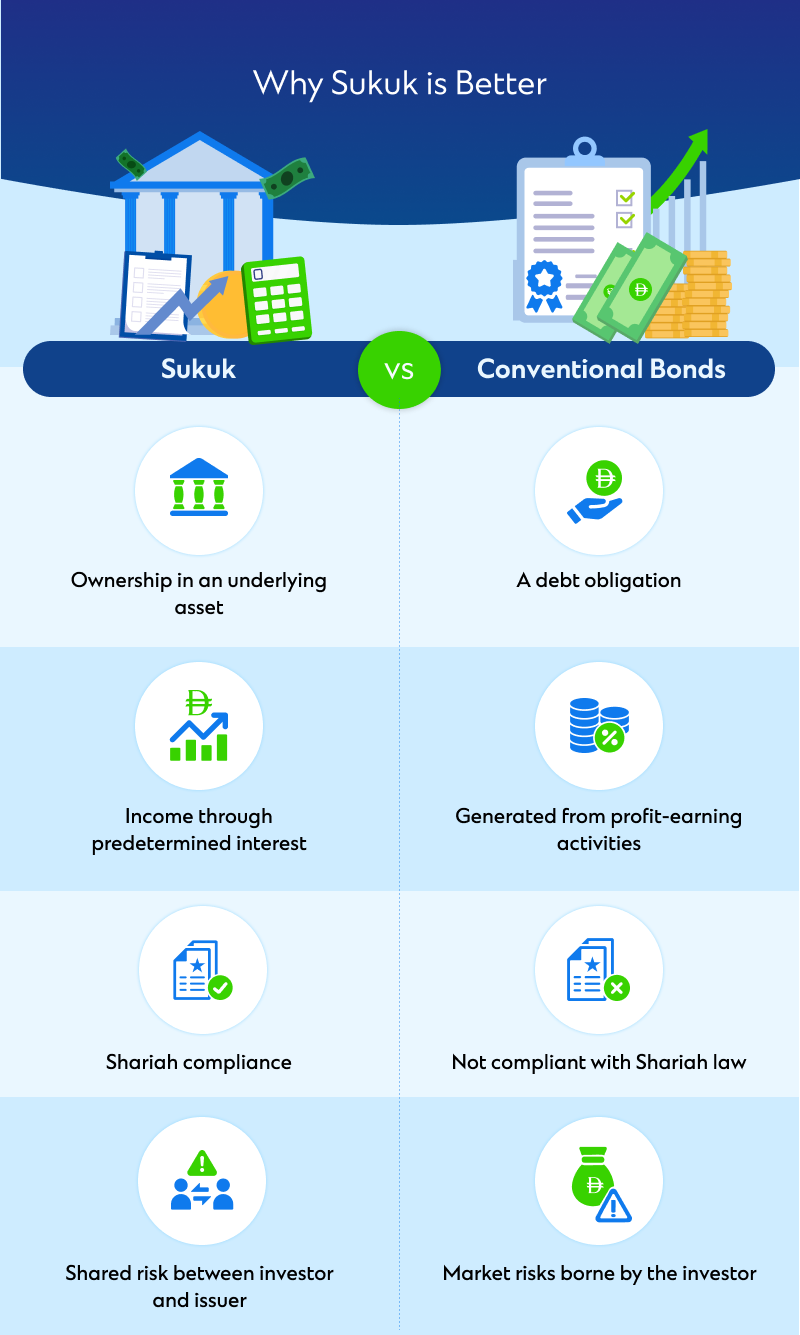
Despite superficial similarities, bonds and sukuk are structurally and ethically different in terms of how it responds to market stress, investor expectations and global regulation. Here’s how sukuk murabaha stands apart:
| Feature | Bonds | Sukuk Murabaha |
| Return mechanism | Interest (riba) | Pre-agreed profit margin |
| Compliance framework | Secular financial standards | Islamic commercial law |
| Asset backing | Not mandatory | Mandatory |
| Risk-sharing | Rare | Embedded in structure |
| Ethical screening | Not typical | Core requirement |
Sukuk investment use cases for today’s portfolios
For high-net-worth individuals (HNWIs) and family offices, sukuk offers a versatile tool for diversification. Sukuk Murabaha serves key functions in:
- Capital preservation: Predictable profit structures make it suitable for low-risk allocations.
- Cash flow planning: Fixed payment schedules align with income-driven strategies.
- Shariah mandates: Ideal for Islamic investors who require strict compliance without sacrificing efficiency.
In corporate finance, sukuk murabaha is commonly used for working capital needs, supply chain financing, or short-term project funding—especially when conventional borrowing breaches religious principles.
How regulators view Sukuk murabaha globally
Sukuk murabaha is widely accepted across jurisdictions with developed Islamic finance frameworks. Regulatory bodies such as Accounting and Auditing Organisation for Islamic Financial Institutions (AAOIFI) and Islamic Financial Services Board (IFSB) provide clear structuring guidelines.
In Malaysia—one of the most active sukuk markets—authorities have enabled robust frameworks for issuance, compliance, and investor protection. These safeguards ensure that sukuk murabaha maintains its legitimacy, liquidity, and cross-border appeal.
International demand is also driven by Environmental, Social, and Governance (ESG) mandates, as the transparency and ethical underpinnings of sukuk align well with sustainable finance objectives.
Evaluating sukuk investment in a multi-asset strategy
Sukuk murabaha may not offer the upside potential of equities or longer-tenure sukuk (like musharakah or ijarah), but it plays a crucial role in liability-driven investing (LDI) and capital allocation planning.
For wealth advisers and investment managers, it acts as a “defensive sleeve”—offering capital stability without liquidity compromise. In periods of volatility or rising interest rates, the structure’s fixed, ethical cash flow model helps anchor portfolio returns.
Sukuk murabaha for the discerning investor
In an era where compliance, stability, and ethical clarity are increasingly sought after, sukuk murabaha offers a high-integrity alternative. It brings together the structural rigour of Islamic finance and the performance discipline required by sophisticated investors.
Whether used in private mandates, institutional fixed income portfolios, or wealth preservation strategies, sukuk murabaha demonstrates that ethical investing can be both resilient and rewarding.
Speak to Standard Chartered’s relationship managers or contact us to learn more about investing in sukuk murabaha.